
Slotbound Cores modify the decisions around your slot machine and run. Choose a Core for an effect you can actually trigger. A gold-generating option, a discount after a loss and a board-rotation tool solve different problems; their rarity labels do not make them interchangeable.
This guide starts with three effects visible in the official Steam media, then explains how to evaluate a choice. It also records the newer Core Rate-Up unlock requirements. It is a focused reference, not a claim to contain every Core or a tested universal ranking.
Three Cores you can compare
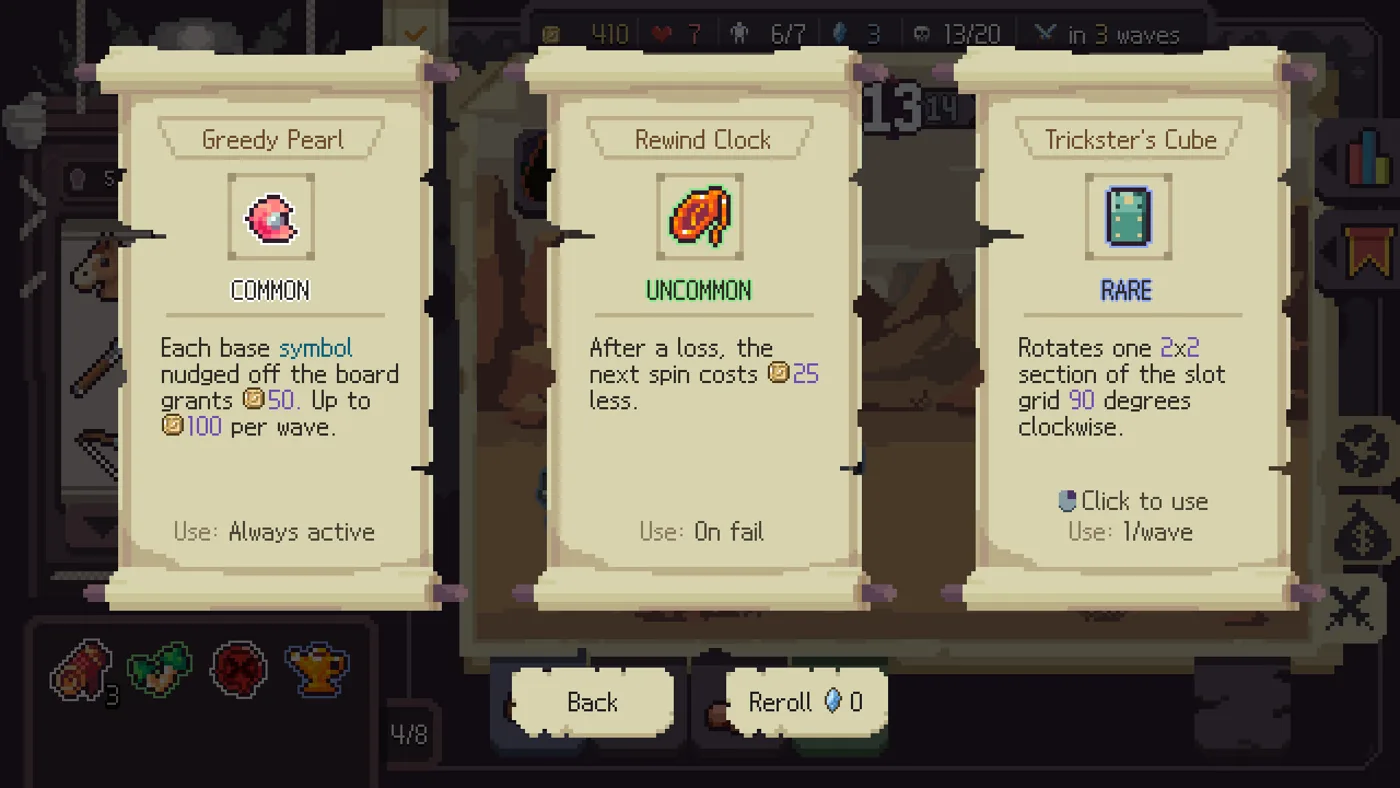
The official screenshot below shows the following options. Its exact game build is unspecified, so check the current tooltip before making a numerical decision.
| Core | Listed grade | Effect shown in official media | Decision to make |
|---|---|---|---|
| Greedy Pearl | Common | 50 gold for each base symbol nudged off the board, capped at 100 per wave | Will you use the relevant nudge often enough? |
| Rewind Clock | Uncommon | The next spin costs 25 less after a loss | Is the discount relevant to the spins you can afford? |
| Trickster’s Cube | Rare | Rotate a two-by-two section 90 degrees clockwise, once per wave | Can that rotation improve the current board? |
These are different kinds of value. Greedy Pearl is conditional income, Rewind Clock changes a later cost, and Trickster’s Cube gives you a board action. Comparing them only by the amount of gold printed on a card misses the purpose of the rotation option.
Start with the trigger
Read the word that activates the effect. A Core can depend on a loss, a nudge, a particular board arrangement or another action. If your intended play does not create that condition, the effect may sit unused. A powerful-looking maximum is not the same as a benefit received on every wave.
For a nudge-dependent Core, ask what you normally use the nudge to accomplish. A move made solely to collect a small amount of gold might prevent a better matching opportunity. You need to compare the resulting board, not just the extra income. This guide does not assume a particular nudge replacement rule because older descriptions conflict; use the preview and tooltip in your current game.
For a loss-triggered discount, do not deliberately seek failure just because the next cost is lower. The useful comparison is between what you can do after an ordinary losing spin and what the alternative Core would have contributed. A discount can reduce a cost without making that next spin affordable or worth taking.
For a rotation tool, inspect all four cells in the selected square. Work through where each symbol will land before committing. A move that improves one potential line can disrupt another. Taking a moment to read the board is part of getting value from the Core; the rarity badge does not do that work for you.
Evaluate the army as well as the reels
Your army supplies the context for a Core choice. If the next summon could provide essential absorption material, a machine-control effect has a different purpose than it does on a board that already has its main roles covered. If your army is losing before its damage dealer can contribute, extra rolls may help, but only if you turn them into a useful structural change.
Decide what needs fixing before selecting the Core. “I need a reliable way to develop my receiver” is a better starting point than “Rare is stronger than Common.” Once the problem is clear, compare whether the offered effect acts on it directly, indirectly or not at all.
A simple planning table can help:
| Current problem | Question for the offered Core |
|---|---|
| You cannot afford another useful action | Does this effect change that now, or only after a later trigger? |
| You keep missing a useful line | Does the board action genuinely improve this arrangement? |
| The army lacks a needed role | Can this effect help you obtain or develop it without sacrificing survival? |
| Your plan needs one specific unit | Is that dependency realistic with your current unlocks and resources? |
These questions are editorial decision aids. They do not imply that a Core guarantees a summon or a clear.
Core Rate-Up unlock requirements
The v1.0.0 (9) update lists three requirements: clear Stage 1 on Normal, unlock five Cores, and pay 20 upgrade currency. Check all three before diagnosing a locked option as a bug.
Clearing the stage and unlocking enough Cores are separate requirements. Likewise, meeting prerequisites does not mean you have already purchased an upgrade. Look at the tree’s current state and your available currency. If one requirement remains unmet, that gives you a concrete next task.
The announcement makes access earlier and cheaper, but it does not publish a full mathematical description of the Rate-Up probability. This page therefore does not invent a percentage or promise a specific Core. Read the live upgrade text for the effect after unlocking it.
If you are following an older guide, compare its date with the patch. A route written before the new requirements may send you into a later stage unnecessarily. Our updates page keeps the change next to the affected guide so you can see which instruction has been replaced.
The old Core system is not a reliable shopping list
The developer described v0.3.0 as an almost complete Core rebuild. That is a stronger warning than an ordinary number adjustment. An early demo tier list may discuss an option that was redesigned or replaced, not merely made slightly weaker.
Before copying a recommendation, match the exact name and effect to your game. If the name matches but the trigger differs, treat it as a different decision. If the footage uses a different machine or an earlier interface, the demonstration may still be interesting but is not a current instruction sheet.
This is also why the three examples on this page are bounded by their evidence. The official screenshot lets you inspect the text directly. It does not prove the screenshot was recaptured for the latest hotfix. For the final choice, the tooltip in your run is the most specific source available to you.
A practical choice example
Suppose you have a working army and are choosing between a resource effect and a board-manipulation effect. First look at the number of useful opportunities remaining. An effect that requires repeated triggers needs time and relevant actions. A board tool might solve a visible arrangement immediately, but only if the move actually creates value.
Now consider your willingness to use it. A rotation effect that you regularly forget to activate may contribute less to your own runs than a simpler effect you understand. That is a practical learning consideration, not a statement that the simpler Core is objectively stronger.
Finally, record what changed after taking it. Did you use the trigger? Did it enable the purchase or line you planned? Did the resulting army improve? Reviewing one explicit expectation teaches more than attributing every win or loss to the Core’s rarity.
Common questions
Should I always take a Rare Core? No universal rule is established by the sources used here. Compare trigger, timing and fit. A conditional effect can be valuable only when its condition occurs.
Why is Core Rate-Up still locked after my clear? Check difficulty, the number of unlocked Cores and the required currency. A Stage 1 Easy clear is not the Normal clear named in the current patch.
Does a Core replace imprints? They occupy different parts of your planning. Cores modify run or machine behaviour; imprints are effects on units. Check both when trying to reproduce a build.
Sources
The three example cards are visible in official Steam screenshots. System history comes from the v0.3.0 Core overhaul; unlock prerequisites come from v1.0.0 (9). All choice examples are editorial reasoning, not results from controlled play tests.
Look up a unit · Plan a build · Check the latest covered patch
Evidence-based editorial guidance. We have not independently play-tested these builds. How we check and update this guide.